Creating Hinge’s First AI Feature

- Consumer
- Social
- iOS/Android
- Product Strategy
- Experience Design
- AI Design
- Org Leadership
I owned the problem that AI strategy wasn’t turning into product, enabled live testing, and built real AI systems and internal APIs so I could ship Hinge’s first AI features and create a repeatable process for teams.
Staff Product Designer
October 2024
7 Months
- Cross Functional VPs
- Cross Functional Discipline Directors
- Two Product Teams
- Daters
- Hinge Engineering Team
Dating often leaves people feeling uncertain and inauthentic. They don’t know what to say, how to represent themselves honestly, or how to move forward with confidence at different moments in the journey.
Hinge had no way to place AI directly into these moments of user uncertainty. The team couldn’t test whether AI could actually help people express themselves or feel guided in real dating situations.
AI investment increased without producing shipped experiences that users could feel or trust, creating risk that spend and opportunity were growing while user value remained unproven.
The Finale
First shipped AI feature
Repeatable AI execution model
Teams gained the tools and process to ship AI features
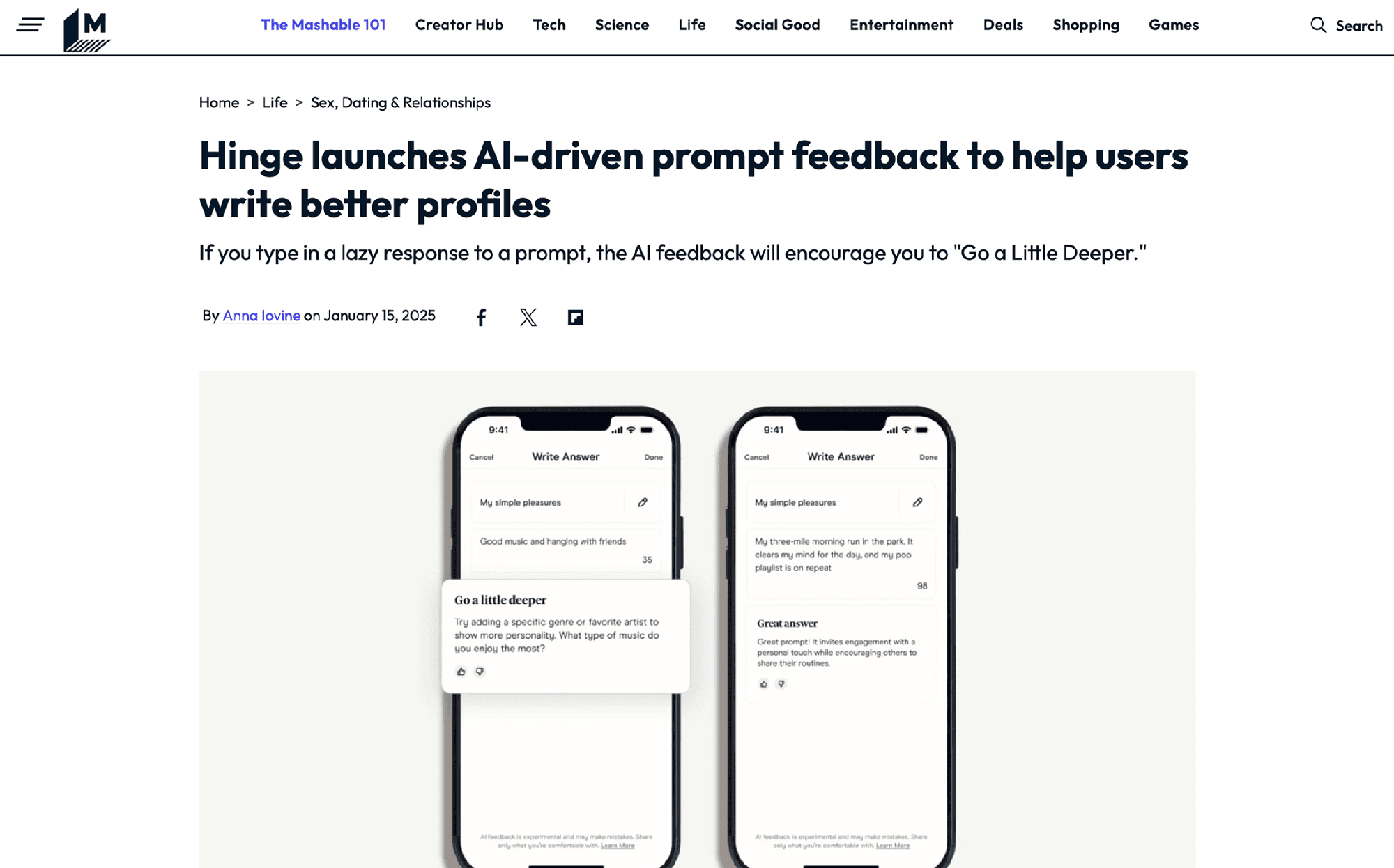
This work produced Hinge’s first shipped AI feature and established a repeatable execution model. Before it, AI discussions ended in opinion and deferral. After it, they ended in shipment or clear rejection. When the sprint ended without ownership, I carried the work forward and partnered with the Identity team to ship Prompt Feedback, doing the invisible work beyond Figma required to make it real.
Prompt Feedback shipped as Hinge’s first AI feature validated with real users, reducing low-quality prompts by 33%, increasing high-quality responses by 174%, and doubling conversation-to-app download rates. In parallel, I rebuilt the AI vision as an end-to-end working system, ran a second Labs sprint with real daters, and institutionalized demo days, making it the gate every AI feature now passes.


7 Months Earlier
Labs Team (Lead PD, Staff Data Engineer, Lead UXR), Identity Team (PM, DES, UXR, DA)
New York, NY Hinge HQ
Whether AI decisions would translate into real product
By the time the AI Vision Sprint launched, AI was no longer theoretical. The decision frameworks I created had aligned the organization on what responsible AI in dating could be, but that alignment introduced a new risk. If the sprint produced only decks and concepts, it would undo the progress that made AI decidable.
With teams pulled from core work and skepticism still high, failure to produce something tangible would retroactively invalidate the work. At the same time, no team at Hinge had any way to evaluate AI in a live product environment.

The Conflict
Vision without execution
No live AI evaluation medium
Design theater at company scale
Vision moved faster than execution. There was no live AI evaluation medium, no shared way to test ideas with real users, and no technical path from concept to product. As a result, leadership discussions turned into design theater at company scale, where promising AI ideas accumulated without any system capable of shipping them.
The Climax
Build live AI systems
Develop OpenAI endpoints + internal Hinge API
Vision → use
I decided AI work would only matter if it could run end to end in a real product environment. I built live AI infrastructure with OpenAI-backed endpoints and an internal Hinge API, closing the gap between prototype and production.
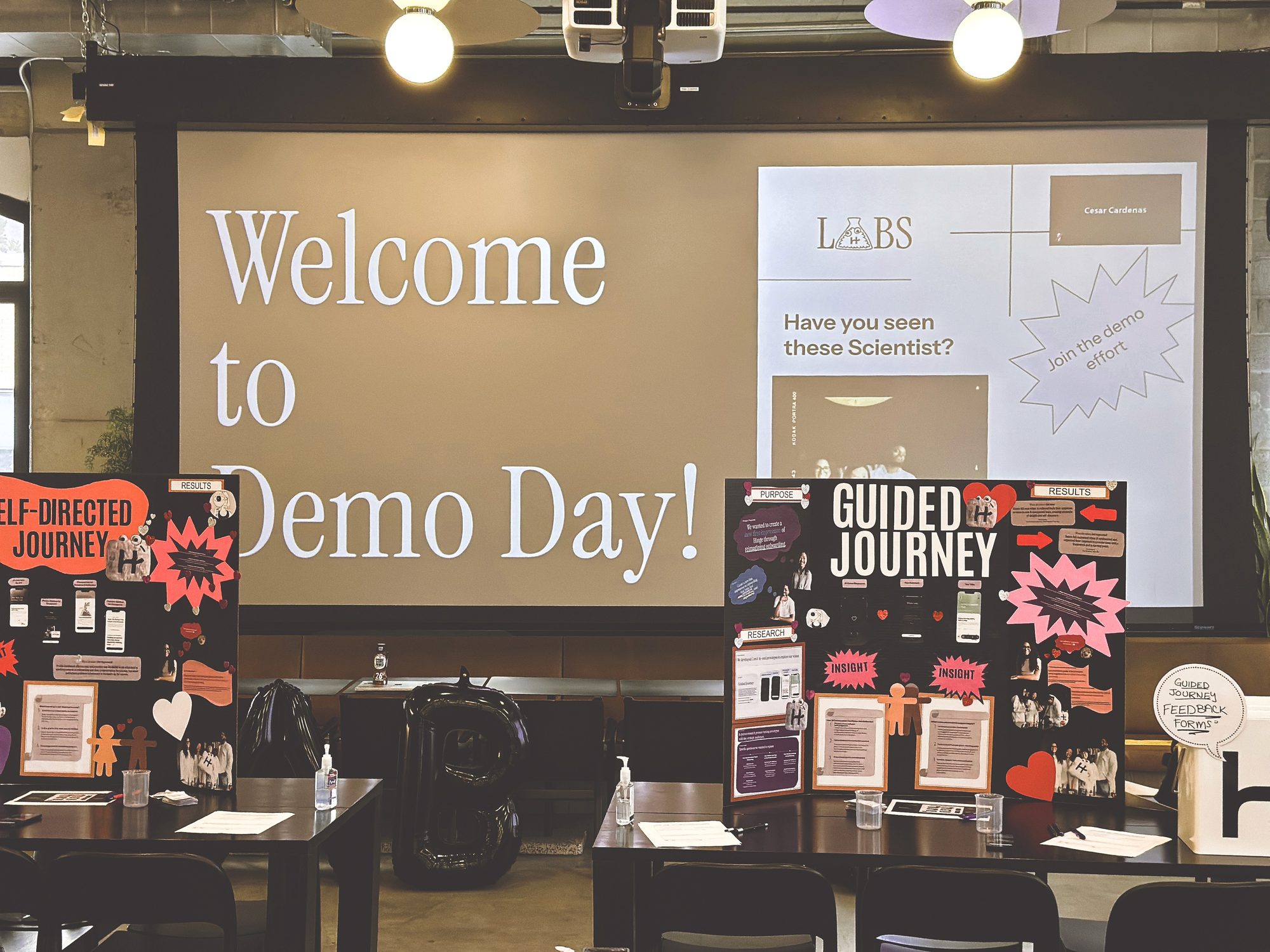
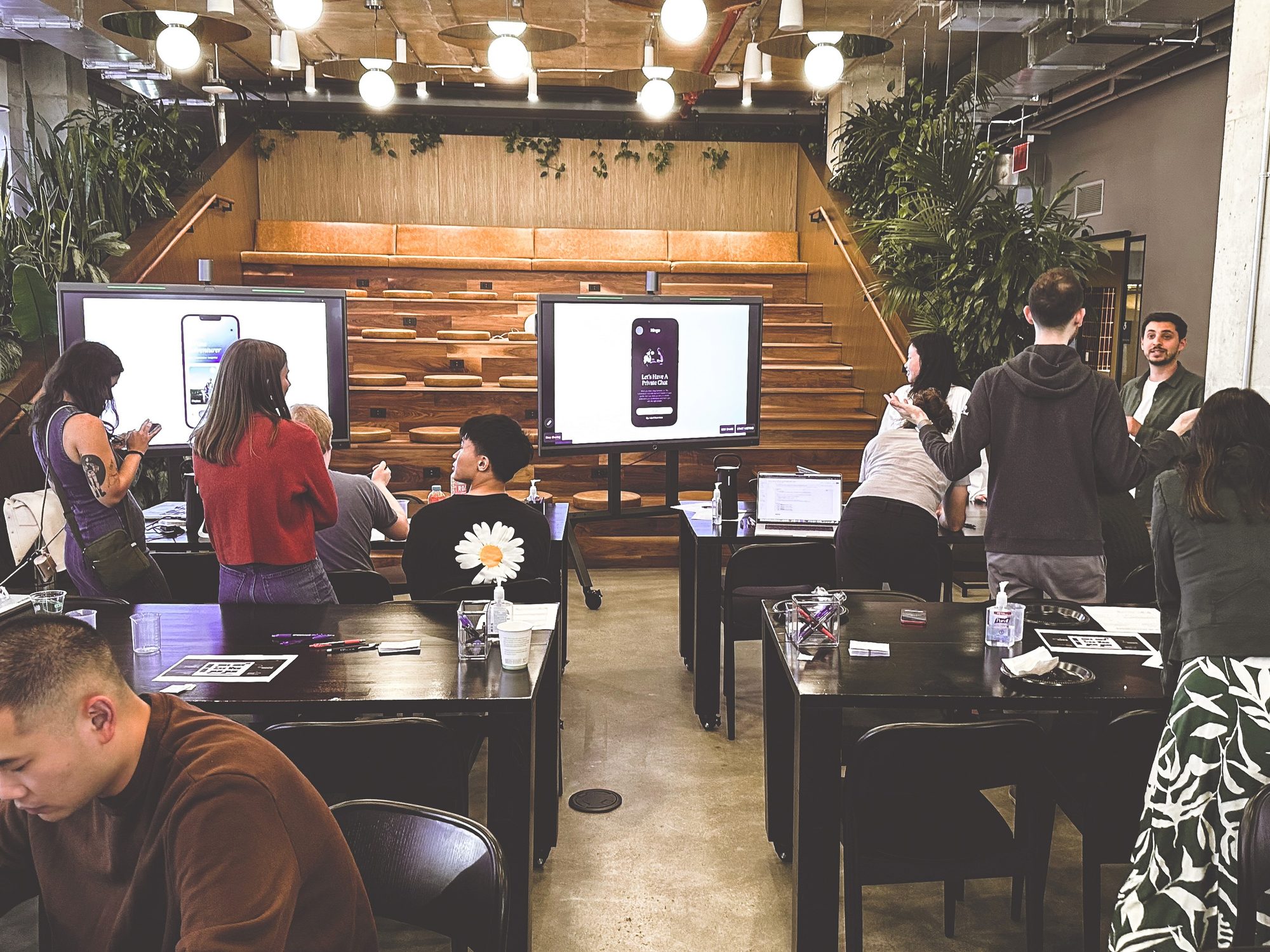
During the AI Vision Sprint, I shifted the focus from concepts to execution by wiring live AI into design prototypes and ending the sprint with a demo day where ideas were used, not debated. That moment turned Prompt Feedback from speculation into a shipping decision and set the foundation I later carried forward in Labs to build the broader end-to-end AI experience.
Details
0→1 Product + Platform Creation
- Design Leaders
- Product Leaders
- Engineering Leaders
- Organizations facing an inability to execute vision
“Vision doesn’t fail. Execution does.”
Est. $2.8–3.4M over 7 months
Est. $12–20M attributable value